ServicesGutters
Gutters in Beech Grove
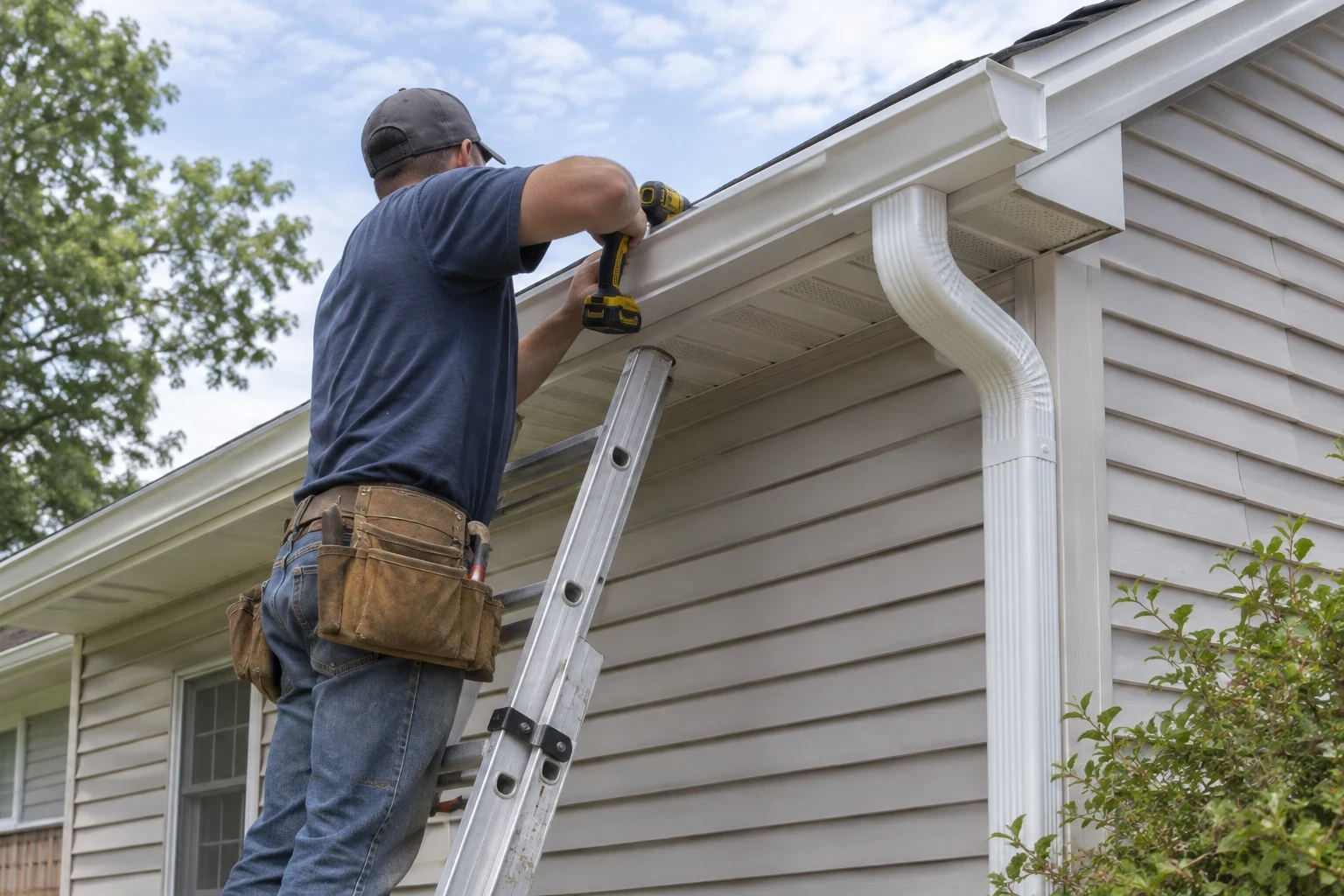
We install and repair gutters after first finding out why the current ones fail. Overflow can come from undersized troughs, a flat pitch, a choked downspout or a missing drip edge. Each has a different fix, and we tell you which one you have.
Gutters Are the Last Step of the Roof's Drainage
Every gallon that runs off your shingles ends up in the gutter. If the trough is too small for the roof area above it, sags between hangers, or drains into a downspout that can't keep up, water spills over the front edge or backs up behind it. Water that gets behind the gutter soaks the fascia board and roof decking. Water that spills over lands next to the foundation.
Because the gutter is tied to the roof edge, we look at both. A gutter that leaks at the back seam is often a roof-edge problem, with no drip edge or gutter apron to carry water past the fascia. Replacing that gutter alone would not stop the leak. Our inspection sorts out which part is actually failing before we quote anything.
Freeze-thaw winters make this matter here. Standing water in a poorly pitched gutter freezes and expands, pulls fasteners loose and adds weight to ice dams at the eave.
What Our Gutter Work Covers
One-piece aluminum runs
We roll K-style gutters from aluminum coil right at your home, cut to the full length of each eave. Joints only occur where a run turns a corner or ends, which leaves very little sealant exposed to weather.
Sizing to the roof
We measure the roof area and pitch draining to each run and choose 5-inch or 6-inch gutters to match. Steep or large roof planes often need the bigger trough and 3x4 downspouts instead of 2x3.
Pitch and hidden hangers
Gutters are set with a steady fall toward each outlet, roughly a quarter inch per ten feet. Hidden hangers screw into the fascia about every two feet so the trough holds its line under wet leaves and ice.
Drip edge and fascia check
Before new gutters go up we check that the roof edge has drip edge or a gutter apron, and we probe the fascia for rot. Soft wood is replaced so the hangers have something solid to bite into.
Downspouts and discharge
We place downspouts where the water volume needs them and run extensions or splash blocks so discharge lands several feet from the foundation.
Repairs and gutter guards
Resealing leaking corners, rehanging sagging sections, clearing blocked downspouts and fitting guards where heavy leaf fall keeps clogging the system.
How to Tell Your Gutters Are Failing
Overflow at the front lip
If water sheets over the outer edge in a heavy storm, the trough is undersized, sloped the wrong way or clogged at the outlet. We pin down which one before recommending anything.
Streaking or soft wood at the eave
Water that slips behind the trough leaves dark stains on the fascia and peels paint on the underside of the eave. Most often the drip edge is missing or too short to reach into the gutter.
Sagging or pulling away
Spikes and ferrules work loose with age, and ice loads speed that up. A drooping section holds standing water and keeps getting heavier.
Pooling near the foundation
Puddles, washed-out mulch or a damp basement wall under a downspout show that water is landing right where it causes the most damage.
Dripping seams and corners
Older sectional gutters depend on sealant at every joint. When that sealant cracks, each seam starts to drip.
How a Gutter Job Goes
- 1
Inspection of roof edge and gutters
We check the roof edge, fascia, hangers, pitch and downspouts, and run water through the system where we can. Each problem gets photographed, and afterward we walk you through the photos and show you the actual source of the trouble.
- 2
Written estimate
The estimate breaks out gutter size, linear footage, downspout count and any fascia or drip edge work on separate lines, so the cost of each part is clear.
- 3
Removal and edge prep
The old gutters come off, damaged fascia is replaced, and drip edge is installed or corrected where it is missing. We shield plantings and keep ladders off fragile surfaces.
- 4
Forming and hanging
A machine on our truck rolls each gutter from coil, and we cut it to the exact eave length and hang it at the correct fall. Outlets and downspouts follow, and a water test confirms everything drains.
- 5
Cleanup
We haul off the old gutters, sweep up screws and aluminum trimmings, and look over the finished work with you.
What Moves the Price of a Gutter Job
The two biggest drivers are the linear footage along your eaves and the condition of the wood the gutters hang from. After the inspection we break every part out on its own line, and financing is available if you would rather spread the cost out. We wait to give a figure until the fascia has been probed, since rot found behind an old gutter can widen the scope.
- Footage and eave height
- Each added foot of run takes more aluminum coil and more hangers. Second-story eaves need taller ladders and safer staging, so they take longer than a single-story edge.
- Trough and downspout size
- A 6-inch gutter paired with 3x4 downspouts uses more metal than a 5-inch gutter with 2x3 downspouts. Large or steep roof planes often need the bigger system regardless, because the smaller one would spill.
- Fascia and drip edge work
- Rotted fascia boards must be cut out and replaced, and missing drip edge installed, before new hangers will hold. Both add material and labor to the job.
- Corners, outlets and guards
- Each mitered inside or outside corner, every extra downspout and any length of gutter guard adds a modest amount to the total.
Common Gutter Questions
Something not covered here? (317) 779-3204
Can my old gutters be fixed, or do they need to come down?
When the trough is in good shape and big enough for the roof above it, rehanging low spots and resealing joints usually does the job. Replacement makes more sense when the gutter is undersized, bent from ice, or a sectional system with leaks at many joints. We photograph what we find and tell you which situation you are in.
My gutters are clean, so why do they still overflow?
A clean gutter can still spill if the trough is too small for the roof area feeding it, if it slopes away from the outlet, or if there are not enough downspouts. On steep roofs, runoff can move fast enough to jump the front lip. We measure roof area, pitch and fall rather than guess.
Will gutter guards keep everything out?
Not everything. Guards block most leaves and twigs, but shingle granules, seed pods and fine grit still settle in and need a rinse now and then. They pay off most where trees hang over the roof.
Should new gutters go on at the same time as a new roof?
That is often the best timing. With the old shingles off, we can set new drip edge and replace bad fascia before the gutters are hung. Our Roof Replacement page walks through how that project runs.
Is hail or wind damage to gutters covered with a roof claim?
Adjusters often list dented or torn gutters along with the roof damage from the same storm. We work with homeowners and insurance companies on storm damage claims, and our Storm Damage Repair page explains how that goes.
Find Out Why Your Gutters Are Failing
We'll check the roof edge, fascia and drainage, then explain the cause and the fix in plain terms. We work in Beech Grove and nearby towns such as Greenwood and Cumberland.